 Home
Home Products
 About Us
 Contact Us
Quenching Oil

Quenching Oil
Quenching is a heat treatment process that involves rapid cooling of heated metals. This process includes immersing the heated metal in an oil bath, which absorbs heat from the material and results in the production of a hardened structure. The choice of oil as a quenching medium depends on factors such as the desired hardness, material composition, and the specific application requirements. The selection of oil, quenching technique, and process parameters all play a crucial role in achieving optimal results. Understanding the principles and techniques of oil quenching also enables manufacturers to produce high-quality hardened parts for a wide range of applications.
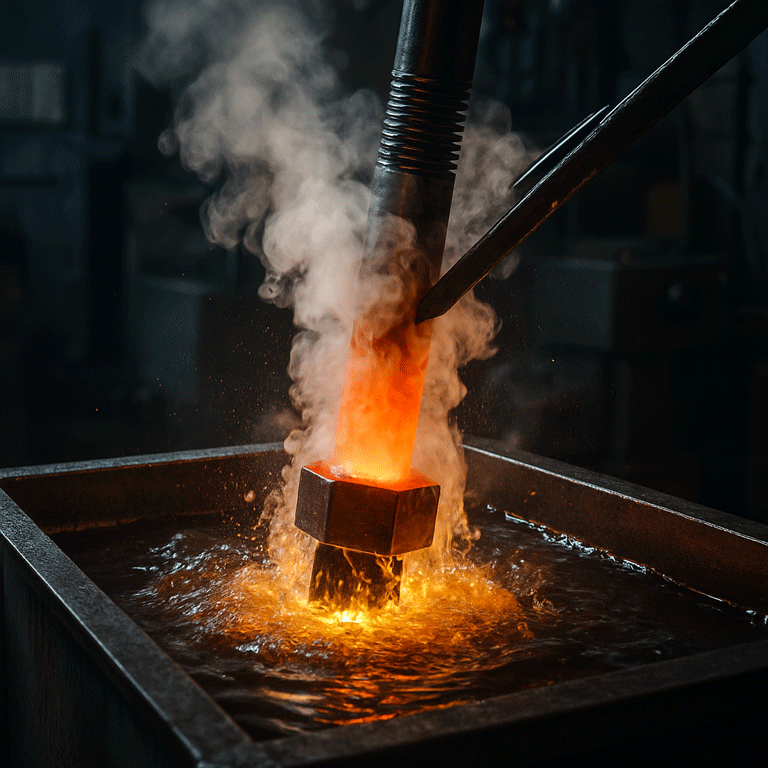
Stages of Oil Quenching
Oil quenching is carried out in three main stages:
Stage 1: Vapor Formation
In this stage, a vapor blanket forms around the part immersed in oil because the part is hotter than the quenching liquid.
Stage 2: Boiling Stage
Here, the quenching liquid itself starts to boil. During this stage, the immersed parts cool rapidly as the vapor blanket dissipates, allowing the quenching liquid to come into direct contact with the parts and effectively remove heat through boiling.
Stage 3: Convection Stage
The final stage of oil quenching, where heat is removed from the parts through convection and conduction.
How Does Quenching Oil Work?
When a metal is heated to high temperatures and then rapidly cooled, it undergoes a phase transformation. During heating, the metal’s crystal structure changes, and after cooling, it transforms into a new crystal structure. This transformation affects the metal’s microstructure and, consequently, its mechanical properties. In oil quenching, the heated metal is immersed in oil, which acts as a cooling medium. The oil absorbs heat from the metal, causing it to cool rapidly. The cooling rate is critical since it determines the microstructure and hardness of the metal.
During rapid cooling, the crystal structure of the metal undergoes a transformation called the martensitic transformation. This leads to the formation of a hard and brittle phase known as martensite. Martensite has a highly strained crystal structure, which helps increase its hardness.
The hardness achieved through oil quenching depends on various factors, including the metal composition, initial temperature, and rate of cooling. For example, high-carbon steels typically attain high levels of hardness with oil quenching. The rapid cooling rate during oil quenching traps carbon atoms in the martensitic structure and increases the steel’s hardness.
Meanwhile, the metal’s microstructure changes during oil quenching. Alongside martensite formation, other microstructural changes such as the dissolution of certain phases or the precipitation of new phases may occur. These changes can affect the strength, toughness, and other mechanical properties of the metal.
Reasons to Use Quenching Oil
– Increases Metal Hardness:
Using quenching oil in the cooling process helps increase the hardness and strength of metals.
– Reduces Stress:
These oils help reduce thermal stresses in parts and prevent cracking.
– Surface Quality:
Quenching oil can help preserve the surface quality of parts, preventing unnecessary repairs.
Applications of Quenching Oil
– Steel hardening
– Cooling metal parts after heat treatment
– Stress relief of parts
– Achieving uniform hardness in parts
Advantages of Using High-Quality Quenching Oil
– Increasing the hardness and strength of parts
– Reducing warping and cracking
– Uniform hardness across the entire surface of the part – Increasing the lifespan of parts
– Reducing maintenance and repair costs
When selecting quenching oil, it is very important to consider its technical properties and the specific needs of the production process. Eriss Kimia Pars Company is one of the major suppliers of high-quality quenching oil on the market and, by offering technical advice and quality products, helps you make the best choice for your industrial processes.

To ensure the quality, performance, and longevity of Quenching Oil, it must be stored under appropriate conditions. Below are scientifically supported guidelines for storing quenching oil:
1. Environment and Location
Store quenching oil in a dry, indoor location, away from direct sunlight, excessive humidity, and extreme temperatures. Avoid storing the oil near sources of heat or flammable materials to reduce fire risks
2. Temperature Control
Maintain a storage temperature range between 10°C to 30°C. Exposing the oil to excessively high or low temperatures may alter its viscosity and flash point, reducing its efficiency.
3. Container Integrity
Use tightly sealed, durable containers designed for industrial oils to avoid contamination from dust, water, or air exposure. Regularly inspect the containers for leaks, dents, or damage.
4. Ventilation and Moisture Protection
Ensure the storage area has adequate ventilation to avoid buildup of fumes and excess humidity. Protect the oil from moisture, which can degrade its anti-rust properties and affect performance during use.
5. Shelf Life Consideration
Quenching oil typically has a shelf life of up to one year when stored under proper conditions. Periodic inspection is advised to monitor its physical and chemical properties before use.
By following these storage standards, manufacturers and industries can maximize the reliability, efficiency, and lifespan of Quenching Oil, ensuring optimal results in industrial processes such as metal hardening and stress relief.