
 Home
Home Products
 About Us
 Contact Us
introduction
In diverse industrial sectors, lubricating oils serve as the lifeblood of machinery, acting as protectants, friction reducers, and rust inhibitors. They keep moving components operating efficiently while minimizing wear and corrosion. Yet, even the most advanced lubricants are susceptible to industrial oil degradation, driven mainly by temperature fluctuations and contamination. Left unchecked, these factors accelerate oil breakdown, compromise equipment longevity, and raise operational costs
This article takes a practical, engineering-focused approach to examine these damaging influences and outline proven methods to preserve lubricant quality, ensuring equipment reliability in the long term
The Impact of Temperature Variations on Lubricants
a) Low-Temperature Effects
Cold operating environments can hinder lubricant performance in several ways
Viscosity surge: At lower temperatures, oil thickens, restricting flow and reducing its load-bearing capacity
Stiffening in narrow passages: Heavy, sluggish oil struggles to circulate through bearings and channels
Phase separation or gelling: Extreme cold can cause base oil and additives to separate or partially solidify
Additive precipitation: Certain chemicals may fall out of solution, clogging lubrication lines
b) High-Temperature Effects
Excess heat is one of the strongest accelerants of industrial oil degradation
Rapid chemical breakdown: Following the Arrhenius equation, oxidation rates double with every 10°C rise
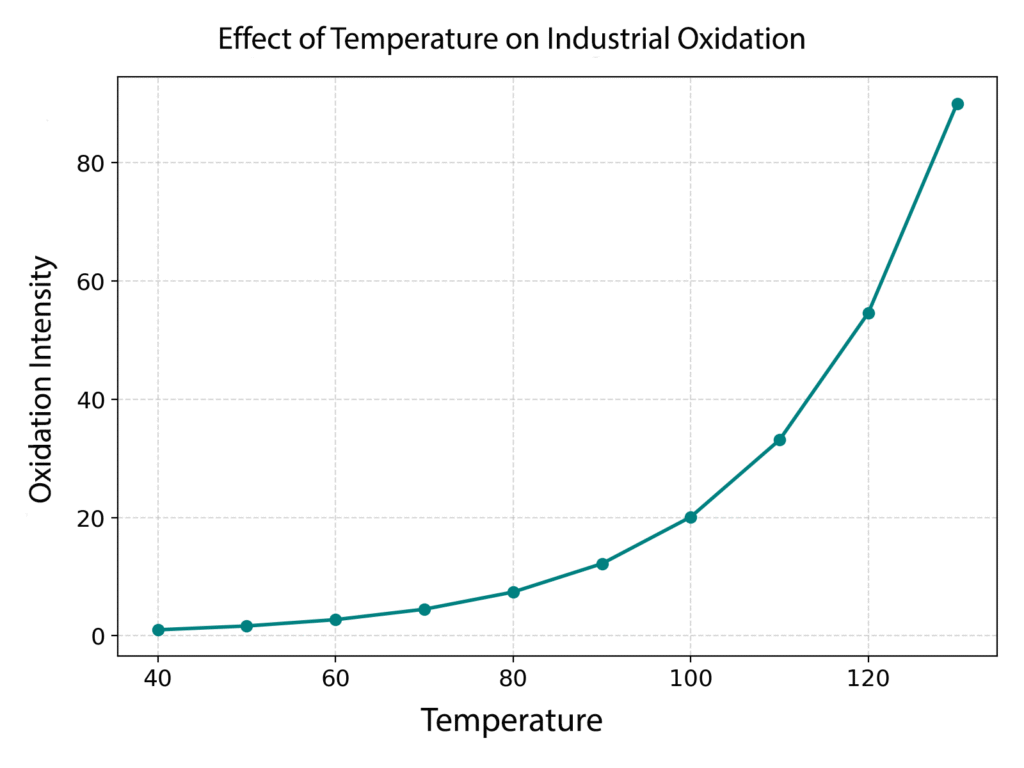
Accelerated oxidation: Leads to acidic byproducts, sludge formation, and filter blockages
Additive depletion: Anti-wear and anti-oxidant agents lose effectiveness under sustained heat stress
Volatilization: Lighter oil fractions evaporate, altering viscosity and chemical balance
Sludge-induced viscosity increase: Deposit buildup thickens oil, reducing lubricating ability
Temperature control practices
Maintain heat within recommended thermal ranges via Thermal Lubrication Charts
Install multi-point temperature sensors
Apply cooling systems and adequate ventilation in hot environments
Contamination Types and Their Role in Oil Degradation
a) Water Ingress
Water is among the most destructive contaminants for lubricants
Produces stable emulsions that impair lubrication
Disrupts the oil film between metal surfaces
Accelerates oxidation reactions
Promotes corrosion, especially in bronze or ferrous components
b) Solid Particles
Dust, sand, and grit: Cause abrasive wear
Metal shavings: Indicate wear-in-progress and exacerbate damage
Foreign greases: Mixing incompatible grease bases—like calcium and lithium—can cause chemical gelation
c) Incompatible Chemicals
Mixing oils with different base stocks or additive packages can trigger chemical instability
May cause filter clogging, sludge, or gel formation over time

For deeper insights into safe handling and usage, explore our related article: Key Considerations in Lubricant Safety Practices.
Case Study – Real-World Lubricant Failure
Scenario
In a metal drawing plant, gearbox lubricants degraded to a paste-like state. Testing revealed
High water content
Silicon contamination from dust ingress
Calcium levels exceeding 3100 ppm from calcium-based grease
Bearing temperatures spiking to 90°C, gearbox oil temperature reaching 100°C (well above the safe limit of 75–80°C)
Consequences
Rapid oxidation and chemical breakdown
Heavy sludge and adhesive deposits
Elevated metal particle counts (Cu, Sn, Fe) indicating severe wear
Conclusion
The combination of elevated temperature, moisture, and incompatible materials created a high-stress environment, drastically shortening lubricant and equipment life
Practical Measures to Prevent Industrial Oil Degradation
Temperature Management
Real-time monitoring via sensors
Use of thermal reference charts
Implementing effective cooling systems
Contamination Control
Use high-efficiency filters and maintain seals
Prevent moisture ingress by securing storage and transfer points
Avoid cross-contamination between incompatible lubricants
Routine Oil Analysis
Regular testing for water content, solids, and acidity
Adjust oil change schedules based on operating conditions
Operator Training
Teach safe handling and storage practices
Train staff to recognize early signs of degradation
By consistently applying these preventive measures, industries can extend lubricant service life, reduce maintenance downtime, and safeguard asset health
Want to strengthen your maintenance strategies? Read our guide: Understanding the Fundamentals of Lubrication.
Industrial Oil Degradation FAQ
Unusual temperature rise and darkened oil appearance are often the earliest indicators.
Every 500 operating hours or quarterly, whichever comes first.
Yes, synthetics generally offer higher thermal stability and better oxidation resistance.
Absolutely. High humidity increases the risk of moisture contamination and corrosion.
No. Mixing incompatible oils can cause chemical reactions that worsen degradation.
Particles create micro-abrasions on metal surfaces, leading to increased friction and faster oxidation.
Most lubricants degrade significantly above their recommended maximum, typically around 80°C for industrial gear oils.
Filtration can remove particles and water but cannot reverse chemical breakdown.
Mining, steel, food processing, and power generation face higher risks due to harsh conditions.
Sensors track real-time viscosity, temperature, and contamination, enabling early intervention.
no comment