
 Home
Home Products
 About Us
 Contact Us
Industrial Oil Standards: An Essential Overview
In the modern era, the growing complexity and precision of industrial machinery has made using high-quality, standardized lubricants and industrial oils a necessity. Industrial oils not only play a crucial role in lubrication, reducing friction, dissipating heat, and preventing corrosion, but they also ensure the efficiency and longevity of industrial equipment. The importance of this issue is that major companies and industries worldwide are constantly seeking to use oils that comply with international standards to achieve optimal performance. In this article, we provide an overview of the history and role of the most important global standards organizations in the field of industrial oils, and we discuss some of the most important standards in the oil industry
?What is the standard and why is it important for industrial oils
industrial oil standards consist of a set of guidelines, criteria, and specialized tests aimed at guaranteeing product quality, performance, and safety. The presence of international standards ensures producers, importers, and end-users that the industrial oil utilized in severe and variable conditions possesses the required quality. Furthermore, compliance with standards establishes a common technical language across different countries, streamlining international trade

Discover more about types and uses of industrial oils in our article: Industrial Oils; Characteristics, Classification & Application.
The history of standard development
The formulation and application of lubricating oils have been fundamental since the dawn of modern machinery. However, for much of its early history, the lubricant oil industry struggled with inconsistencies and a lack of standardization. Initially, both users and manufacturers depended primarily on basic tests and personal experience to assess oil quality. This approach frequently resulted in unpredictable performance, increased engine wear, and more frequent mechanical failures. As the automotive and industrial revolutions accelerated in the early twentieth century, the growing diversity of engine types and operating environments further highlighted the urgent need for reliable, standardized guidelines. Only with such standards could lubricant quality keep pace with the rapidly advancing demands of modern technology
The most important global standards organizations
The American Petroleum Institute (API)
Among all the standards organizations affecting lubricants, the American Petroleum Institute (API) stands as the most influential. Founded in 1919 to represent the U.S. oil and natural gas industry, API quickly recognized the necessity of categorizing and certifying lubricants based on their ability to protect engines under different conditions. The result was the development of a series of “Service Classifications” for engine oils, such as the familiar API SN for gasoline engines and API CK-4 for advanced diesel engines. API standards are updated regularly, reflecting new engine designs, emission control requirements, and performance advancements. The API “donut” and “starburst” marks on lubricant packaging have become globally recognized symbols of oil quality and performance, making API the governing voice for engine oil standards in many regions of the world
The Society of Automotive Engineers (SAE)
Viscosity classification, rather than performance properties, became the primary focus of the Society of Automotive Engineers (SAE), leading to a transformative role in lubricant standardization.Established in 1905, SAE developed and refined the “SAE viscosity grading system” beginning in the 1920s. Before these grades were widely accepted, confusion abounded as manufacturers used various, often arbitrary, measures of oil thickness. SAE’s standardized viscosity grades—such as SAE 5W-30 for multi-grade oils or SAE 40 for mono-grades—set clear benchmarks for how lubricants should behave under cold start and high-temperature conditions. This helped carmakers, mechanics, and end-users select oils that matched their engine’s design and the ambient climate, boosting reliability and engine protection industry-wide
ASTM International
At the core of industry standards, ASTM International (formerly the American Society for Testing and Materials) has established itself as the backbone of test method standardization for lubricants and their components. While ASTM does not develop product specifications or classification systems directly, it provides universally accepted methodologies for measuring crucial lubricant properties such as kinematic viscosity (ASTM D445), pour point (ASTM D97), and oxidation stability (ASTM D943). Consequently, these standardized laboratory procedures are referenced by API, SAE, and other global organizations, ensuring that tests are repeatable, reliable, and comparable worldwide. Therefore, ASTM’s influence in the lubricant oil industry is often indirect, yet it remains profound, underpinning every reputable certification on the market
International Organization for Standardization (ISO)
As the lubricants market became increasingly globalized, the International Organization for Standardization (ISO) entered the arena as a unifying force, harmonizing standards across borders. Founded in 1947, ISO developed numerous standards for industrial lubricants and hydraulic fluids (such as ISO VG grades for industrial oil viscosity and ISO 6743 for lubricant classification). ISO standards play an especially significant role in non-automotive fields: manufacturing, heavy equipment, and specialized machinery all rely on these globally agreed frameworks to ensure compatibility and performance across different markets, making ISO a critical player in industrial lubricant standardization
How Standards Organizations Shape Industrial Oil Standards
To begin with, the close interplay among API, SAE, ASTM, and ISO has created a synergistic foundation for modern lubricant oil development. When it comes to engine oils, API specifications define required performance levels. At the same time, ASTM provides test methods to verify those properties. Furthermore, SAE defines the required viscosity grades, and ISO ensures global application, particularly for industrial lubricants. Overall, the clear division and cooperation among these organizations are essential; each excels in its own role, building a robust structure that addresses performance, safety, testability, and international harmonization.
The process for developing, updating, and maintaining these standards has become increasingly transparent and inclusive. Committees within each organization routinely assess advancements in engine technology, changes in regulations—including those promoting environmental sustainability—and feedback from both oil producers and end users. For instance, the API Lubricants Group and the SAE Engine Oil Viscosity Classification Task Force conduct thorough technical reviews and field testing before approving any new specification or grade. In the same way, ASTM test methods are carefully vetted and continually refined in light of the latest research and practical experience. Additionally, ISO brings together experts from numerous countries to build consensus, ensuring each standard has broad relevance and industry acceptance
The world of lubricants continues to evolve with technology—tighter emissions regulations, extended drain intervals, hybrid and electric vehicles, and industrial automation each drive new requirements. The enduring strength of the industry lies in its standards bodies’ ability to adapt and innovate while maintaining the rigorous procedures necessary to uphold global confidence in lubricant performance. For users—from car owners to equipment manufacturers—these evolving standards translate directly into safer operation, increased reliability, and longer equipment life
Key ISO Standards for Industrial Oils
ISO 3448
This standard classifies industrial oils according to their kinematic viscosity at specified temperatures. Viscosity is one of the most vital properties of oil, directly influencing its behavior under movement and its effectiveness in lubricating machinery. The ISO 3448 categorization is particularly significant for selecting suitable oils for different operational requirement
ISO 6743
This is a comprehensive classification framework for various oils and lubricants, coding them for different industrial applications (such as hydraulics, gears, compressors, etc.). For example, hydraulic oils are coded as HH, HLP, and so on. This classification allows users to make informed choices based on their specific technical and operational needs
ISO 4406
This standard provides a method for measuring and classifying the contamination levels of solid particles in industrial oils. Contamination control is crucial for enhancing equipment lifespan and preventing premature failures. According to ISO 4406, the number of particles in a specific oil sample volume is counted and reported (for example, 18/16/13 denotes the number of particles in three different particle size ranges)

Major ASTM Standards for Industrial Oils
ASTM D445
To begin with, this standard describes the method for determining the kinematic viscosity of transparent and opaque liquids, namely oils. Specifically, using a viscometer, the time taken for a specified volume of oil to flow under controlled conditions is measured, and from this, the viscosity rating is assigned. Moreover, viscosity plays a hugely impactful role in machinery lubrication and the formation of an effective protective oil film
ASTM D97
This test determines the pour point of oils. A low pour point indicates that the oil remains fluid and functional at lower (colder) temperatures, preventing solidification or pumpability problems. This test is particularly important for oils used in cold climates and outdoor industrial applications
ASTM D92
This method measures the flashpoint, which is the temperature at which oil vapors ignite. Flashpoint is a critical safety measure, helping manufacturers and users evaluate and manage the risk of fire or explosions in storage and application
National and Regional Standards
In addition to global organizations like ISO and ASTM, many countries develop their own national and regional standards for industrial oils and lubricants to address local operational needs, environmental conditions, and regulatory requirements. These national standards are tailored to the specific climate, industrial practices, and machine operation patterns found within each country. They help ensure that oils used domestically perform reliably and safely under local conditions. For example, the Institute of Standards and Industrial Research of Iran (ISIRI) establishes numerous national standards for lubricating oils. These standards often specify requirements for viscosity, quality control methods, base oil type, and additive content, and are frequently harmonized with international benchmarks while addressing the unique challenges of the domestic market. Adhering to national and regional standards not only supports local industry needs but also enhances the safety and efficiency of machinery and facilitates smoother regulatory compliance
Key ISIRI Standards for Industrial Oils
ISIRI 6503 – Industrial Lubricating Oils – General Requirements
This standard specifies the general requirements and classification methods for various industrial lubricating oils, including properties such as appearance, viscosity, and purity. It serves as a baseline guideline for manufacturers and users in Iran
ISIRI 6221 – Hydraulic Oils (L-HL, L-HM, L-HV types)
Specifies requirements and testing methods for hydraulic oils commonly used in machinery and industrial systems, focusing on anti-wear properties, oxidation stability, and compatibility with system components
ISIRI 6423 – Internal Combustion Engine Oils
While primarily for motor oils, this standard also impacts oils used in large industrial engines and generator sets, detailing physical and chemical requirements and testing procedures
ISIRI 4748 – Industrial Gear Oils
This standard outlines the classification, performance, and testing methods for oils used in industrial gearboxes, focusing on load-carrying capability, anti-wear characteristics, and resistance to oxidation
ISIRI 3709 – Lubricating Oils – Determination of Viscosity Index
Adopts ASTM D2270 for determining the viscosity index, helping specify whether an oil will perform adequately over a range of temperatures
ISIRI 1744 – Industrial Oils – Determination of Flash and Fire Points
Comparable to ASTM standards, this standard defines the procedure for measuring flash and fire points, crucial for assessing oil safety and fire risk
ISIRI 3707 – Lubricating Oils – Determination of Pour Point
Specifies methods for determining the pour point of industrial oils, important for low-temperature performance
ISIRI 5285 – Lubricating Oils – Determination of Acid Number (TAN)
Describes how to measure the acidity of oils, a key indicator for oil degradation and suitability for reuse
ISIRI 5739 – Lubricating Oils – Determination of Ash Content
This standard determines the ash content in industrial lubricants, which can influence deposits and machinery wear
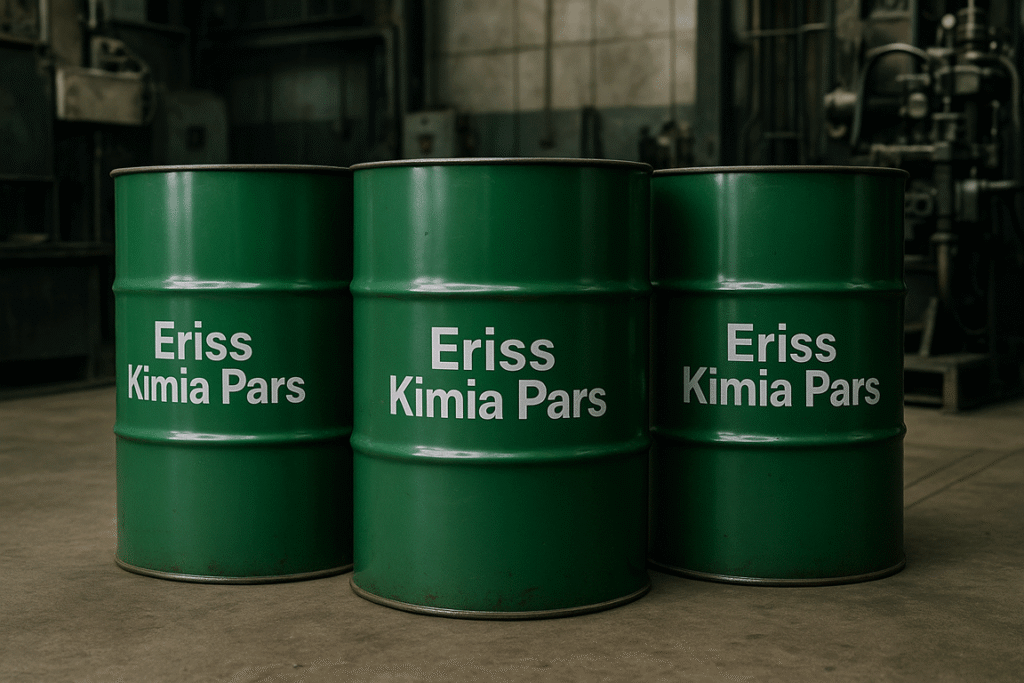
Explore our wide range of high-quality industrial lubricants and oils at Eris Kimia Pars and discover the perfect solution for your machinery needs.
Industrial Oil Standards: Conclusion
In conclusion, the history of lubricant oil standardization closely reflects the evolution of modern machinery. Over time, the industry has shifted from trial and error to scientific rigor and global consistency. For instance, the API continues to serve as the benchmark for engine oil performance, while SAE establishes the viscosity rules. Additionally, ASTM offers robust testing methods, and ISO ensures harmonization across global markets. As a result, the combined efforts of these organizations have not only improved industrial oil standards, but have also enabled consistent progress in modern industry and transportation
industrial oil standardsact as key tools for sustainable development, safety, and efficiency in industries. Understanding and strictly following these standards leads to improved quality, reduced risks, and higher productivity in the industrial sector
Industrial Oil Standards: Frequently Asked Questions
Industrial oil standards are internationally recognized guidelines and test methods designed to ensure the quality, safety, and performance of lubricating oils used in machinery and industrial applications
Standards guarantee that lubricants meet specific quality and performance criteria, supporting equipment efficiency, reducing risks, and enabling easier international trade
The API develops service classifications and specifications for engine oils, ensuring oils meet the required performance standards for various engine types and conditions
Key global organizations include the American Petroleum Institute (API), Society of Automotive Engineers (SAE), ASTM International, and the International Organization for Standardization (ISO)
SAE establishes the widely recognized viscosity grading system for lubricating oils, helping users choose suitable oils based on climate and engine type
ASTM International develops standardized test methods that measure crucial lubricant properties, such as viscosity, pour point, and oxidation stability, ensuring reliable testing worldwide
ISO harmonizes industrial oil standards globally, enabling consistent classification and compatibility across different countries and industries
Key ISO standards include ISO 3448 (kinematic viscosity classification), ISO 6743 (lubricant classification for various applications), and ISO 4406 (contamination level classification)
Using oils that comply with international standards ensures optimal machinery performance, enhances safety, and supports regulatory compliance and global trade
no comment